Although written in 2005, this article is still relevant in today's business/legislative environment.
Issue Date: March, 2005
Best Practices: Auditing Your Suppliers
Sarbanes-Oxley compliance may require your company to monitor your contingent workforce service providers
Brian Korsmeier
Publicly held companies know they must comply with the Sarbanes-Oxley
Act of 2002 by taking responsibility for the effectiveness of internal
controls over financial reporting. This means certifying an annual,
integrated audit of financial statements and internal controls.
Section 404 of the act deals in part with certifying the sufficiency
of controls for detecting fraudulent, questionable or unauthorized
activities that could impact company financial statements. It focuses on
a company's internal controls, but it also requires close scrutiny of
the internal controls of the company's service providers. In fact, not
only service providers to public companies but other service providers
they in turn rely on may fall under this regulatory authority.
The Public Company Accounting Oversight Board (PCAOB), created to
oversee Sarbanes-Oxley (SOX) compliance, has made it clear that
accountability extends to the controls of third-party service providers
whose services directly impact the internal control environment or
financial reporting of a company. Financial Executive magazine
summarized the effect of this provision in its December 2003 issue: "As
far as Section 404 is concerned, an outsourced business process is no
different from one handled internally. In other words, if it impacts
your financials, you are responsible for ensuring that the controls are
effective."
That said, if your company is subject to SOX, your responsibilities
extend to third parties involved in providing contingent workers for
you. Let's examine who is included in this category.
Which Third Parties?
Complying
with SOX requirements inevitably requires grappling with some of the
details of financial responsibilities. It involves both scrutinizing the
accounts or business processes that relate significantly to financial
reporting and looking at how third parties are being used. The former
activity sets the scope of the internal controls to be assessed. The
latter narrows the field of service providers to those whose services
are actually related to the gathering or processing of financial data.
In looking at processes and their related controls, it is useful to
take a deep breath and consider the definition given in PCAOB AU section
324. It says that internal control functions (whether outsourced or
not) include those that affect either procedures by which transactions
are initiated, recorded, processed and reported, from their occurrence
to their inclusion in the financial statements, or related accounting
records that support information and specific accounts in the company's
financial statements. Many of the processes involved in acquiring and
managing your temporary workforce may fit these criteria.
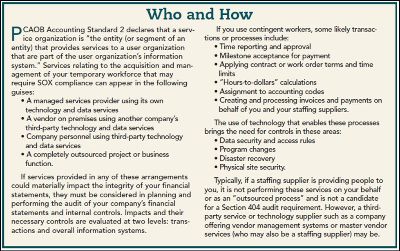
The key to your approach to meeting the compliance requirement is who
is doing the activities. If any part of the process is done for you by a
third party, even a sibling company of yours, there is a good chance
that you are responsible for confirming its internal controls. In this
context, a staffing company providing you with staff augmentation, while
certainly a candidate for periodic audits to confirm invoice accuracy
or contract compliance, probably does not fall under the "service
provider" requirements of Sarbanes-Oxley because the internal controls
are yours, not theirs. (For details, see the sidebar "Who and How.")
You have a range of available options, used separately or in
combination, for determining compliance by the service provider. Your
company may test internal controls at the service organization. You may
obtain a report from an independent auditor that analyzes specific
controls. You may evaluate your own controls over the activities of the
service organization. You may test your controls over data/information
flow to and from the service organization. You may obtain from the
service organization an SAS 70 Type II report prepared by an independent
auditor and paid for by the service organization.
Which option to use typically is the auditor's decision and depends
on the nature and complexity of the third-party services and the level
of interaction between your company and the service provider. For
example, if your company is actively involved in creating a cost
accounting transaction from an approved time sheet, which is then passed
to your service provider to create a consolidated invoice or payment,
it is likely that only selected service provider controls must be
assessed. On the other hand, if the service provider manages the
time-sheet approval, initiates the cost accounting transaction, passes a
consolidated invoice directly to your accounts payable system and then
pays the staffing suppliers on your behalf, it is reasonable to expect a
comprehensive assessment of controls from the service organization.
What is SAS 70?
As noted
above, an SAS 70 Type II report is one way to obtain compliance. In June
2004 the Securities and Exchange Commission (SEC) recognized it as an
acceptable method for obtaining an auditor's opinion for SOX Section
404.
Created by the American Institute of Certified Public Accountants
(AICPA) in 1993, Statement on Auditing Standard 70 has received new
attention since passage of the Sarbanes-Oxley Act. It was established to
tell an independent auditor how to assess the internal controls of a
company providing services to another company and afterward how to issue
an official auditor's opinion. The standard focused on services that
could have an impact on the user organization's financial reporting,
among them payroll services, benefits and claims processing, outsourced
IT operations or data centers, and vendor management services or
software.
The SAS 70 audit's contents are flexible in that the
comprehensiveness of the controls to be reviewed is determined by the
service vendor, though within some standard categories. The resulting
auditor findings are not really "certifications" of compliance to a
standard but are the auditor's opinions regarding those controls,
presented to the service organization.
The basic Type I report presents the service organization's
description of controls at a specific point in time and offers the
auditor's opinion as to the fairness of the description and the
suitability of the design of the controls for obtaining the specified
control objectives. It does not provide an opinion regarding the
effectiveness of the operation of the controls. SOX compliance requires a
Type II report, which adds to the content of a Type I report a detailed
description of the tests of the controls over a minimum period of six
months and the auditor's opinion as to the effectiveness of the tested
controls.
In a pre-Sarbanes-Oxley era, SAS 70 reports might have been used to
satisfy a user organization's RFP or simply required by the client
company in order to do business, or the service provider could have used
them as a competitive marketing tool. In any case, if designed
properly, the reports could provide a sound analysis and the foundation
for internal improvement within the service company.
Now that Sarbanes-Oxley regulations are in place, the SAS 70 Type II
report, if developed properly, seems to satisfy a new need. The AICPA
Audit Guide - Service Organizations was amended in May 2004 to state
that "SAS 70, as amended, addresses the effect that a service
organization may have on a user organization's financial reporting
requirements."
Proceed with Caution
Merely
having an SAS 70 Type II report from a service provider, however, is not
automatically sufficient for Section 404 compliance. It must be heavily
scrutinized for the following four factors:
Timing.
Your company has unique
reporting deadlines based on its fiscal year. The time frame of the
service organization's audit activity must match your requirements for
both when the report is completed and the period being covered.
Scope.
The report must cover all
of the Sarbanes-Oxley internal control components: control environment,
risk assessment activities, control activities, information and
communication systems and monitoring activities. In addition, it should
include controls for which your company is responsible as data flows to
and from the service provider.
Content.
The report must cover
all controls that are critical to your company's financial statements,
not just those selected by the service provider. And it must include all
controls tested, not just those that tested well.
Auditor independence.
The SEC has
determined that there is no conflict if you use the same auditor as
your service provider, but that auditor cannot also provide consulting
services to the provider on how to perform the SAS 70 audit.
In short, be aware that an SAS 70 report offered by your service
provider may not satisfy your company's SOX requirements. It is, after
all, that company's report, not yours. It may be both more prudent and
more cost-effective to utilize one or more of the other acceptable
auditing methods. Your auditing team should make this decision with
management input.And remember, regardless of the method chosen, it is
still the user organization's responsibility - yours, in other words -
to assess the controls properly and potentially to invoke additional
internal controls before and after the interaction with the service
provider.
What If
Under Sarbanes-Oxley,
if your service provider cannot or will not provide an acceptable SAS 70
Type II report or permit access to your auditors, you are the one on
the hook. You and your auditors must determine the significance of not
having it; you cannot simply leave it out if it should be there. In
October 2004, the PCAOB issued additional guidance that essentially says
that the auditor must determine, and state in its report to the SEC,
whether the deficiency represents a material weakness and whether
management has failed to fulfill its responsibilities.
Such a statement can have consequences. Non-compliance potentially
can lead to legal action by the SEC. And if there are sufficient
"material weaknesses" or it becomes clear that management "has not
fulfilled its responsibilities," the investment community may react
negatively.
With temporary workforce spend rates increasing, the integrity and
effectiveness of internal controls merit scrutiny, no matter who manages
the process. If you are handling the entire process and all the
underlying technology for acquiring and managing your temporary
workforce, the internal controls are your own. If you outsource any part
of the process or enabling technology, though, you should monitor the
internal controls of the service providers as a sound business practice;
you must exercise due diligence as a Sarbanes-Oxley requirement.
Therefore it follows that understanding how a service provider
approaches and manages its internal control responsibilities should be a
key criterion in selecting those service providers and structuring the
contractual relationship.
There are volumes of rules, guidelines and standards on this topic,
and they are still changing as the Sarbanes-Oxley era matures. Given the
complexity and evolution of the statutory requirements, your company
ultimately must determine its position regarding Section 404 compliance
by relying on the experience and expertise of your auditors.
Copyright 2005 by Staffing Industry Analysts
available from the SIA website:
|